These are the famous Blue Ridge Mountains that I call home but how did they get so blue? Let’s find out!
During summer days the mountains can be seen as if they are blueish and grayish. Other days they can be seen as sky blue, turquoise or a blueish black or even purple!
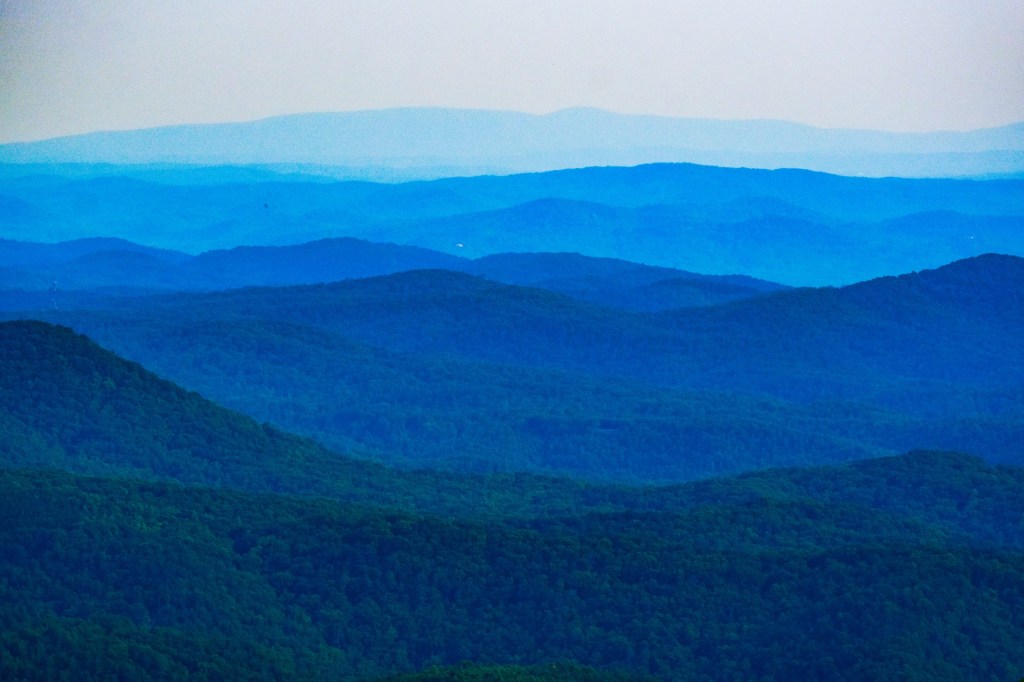
Several debates have been discussed over how they are so blue. One 1964 New York Times article discussed Dr. F. W. Went’s theory on why they are so blue which was then tested by Dr. Reinhold A. Rasmussen and other unknown people, and it was stated that “In 1960, Dr. Went advanced the idea that the blue hazes originated in vapors thrown off by trees-‘ molecularly dispersed organic substances derived from plants,’ as he expressed it. He also went on to theorize that ‘under the influence of light, this material condenses and produces a blue haze.’”
It is also said that the Blue Ridge Mountains produce their color in the distance from the millions of trees which are located in the valley. When these trees and their isoprene, which is an organic compound known to be produced by plants, animals and even humans, are released into the air it creates the blue haze smoke look to the mountains.
Then there is this theory. That the trees are producing fine mists of volatile organic compounds (also known as VOCs) which spreads out the blue light waves.
With all this being said, there is several speculations on how the Blue Ridge Mountains are blue, but one thing is for certain we all know that they are a true masterpiece from the one above.
 Gracie Latrelle
Leave a comment